
Submit to our Terms:
Washington, Trump, and the American Expansionism


One key aspect of the origins of the American Revolution that remains underexamined is how fundamentally it was driven by territorial ambition. Long before liberty became its rallying cry, the Revolution was about land – who controlled it, who was allowed to settle it, and which agreements could be discarded when they became inconvenient.
After the French and Indian War, the British Crown issued the Royal Proclamation of 1763, establishing a boundary along the Appalachian Mountains beyond which colonial settlement was forbidden. This policy reflected Britain’s desire to stabilize the frontier, prevent another costly war, and honor diplomatic commitments made to Indigenous nations, particularly the Haudenosaunee (Iroquois Confederacy), whose alliance had been instrumental in defeating France in the Ohio River Valley.¹
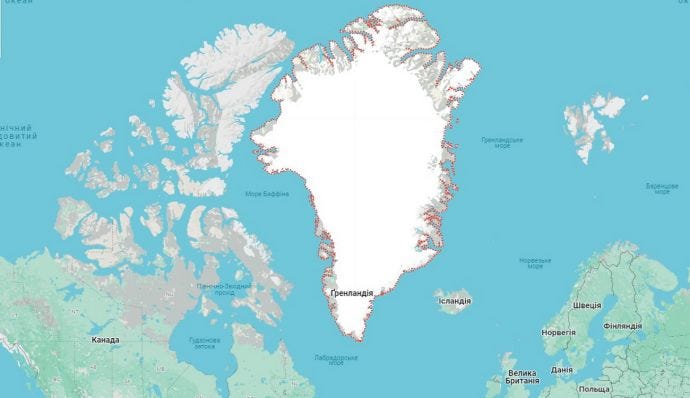
Image: Google Maps
George III’s decision was pragmatic rather than moral. The empire was exhausted, deeply indebted, and keenly aware that further frontier conflict could be disastrous. But for colonial elites – especially land speculators – the proclamation represented an intolerable obstacle. Few embodied this resentment more clearly than George Washington, who had already invested heavily in western land claims. In fact, Washington’s correspondence reveals open contempt for the idea that treaties with Indigenous nations should permanently restrain expansion. In a 1767 letter, he dismissed the Proclamation Line outright, writing that he could “never look upon that proclamation in any other light … than as a temporary expedient to quiet the minds of the Indians.”²
Washington's phrasing here is revealing: Indigenous sovereignty is not denied outright; it is deferred. Treaties exist to manage resistance, not to be honored indefinitely. This attitude was central to the Revolution; independence promised liberation from imperial constraints, including treaties the colonies had never intended to respect. Once free of British oversight, the United States moved swiftly westward, treating Indigenous agreements as provisional obstacles rather than binding commitments. In other words, the Revolution nationalized colonialism.
Washington’s own words after independence confirm this continuity. Writing to James Duane in 1783, he warned that failing to assert control over western lands would invite foreign powers and Indigenous nations to complicate American dominance: “The Western posts ought to be in our hands… otherwise, a few years will show us a numerous and powerful people established on our back.”³ Land was security, expansion was survival. Those already living on that land were a strategic problem to be managed.
As president, Washington publicly endorsed treaty-making while privately preparing for their violation. In a 1793 message regarding frontier conflict, he argued that if Indigenous nations resisted American expansion, they would have to be met with “a force that will compel them to peace.”⁴ Diplomacy, in this framework, was not mutual recognition but a staging ground for coercion. This logic – treat first, expand later, enforce by force if necessary – became a template for American governance. It laid the groundwork for Indian Removal, Manifest Destiny, and the steady transformation of Indigenous homelands into American property. Each step was framed as regrettable but necessary, temporary but inevitable.
Fast forward more than two centuries, and the language changes – but the structure remains intact. When Donald Trump first floated the idea of acquiring Greenland in 2019, he described it bluntly: “Essentially, it’s a large real estate deal.”⁵ The remark was widely ridiculed for its crassness, yet it stripped away the rhetorical veil that earlier leaders carefully maintained. Trump said aloud what Washington and his contemporaries wrote privately: land is an asset, territory is power, and people are secondary to acquisition.
Trump repeatedly framed the proposal in terms of strategic value rather than consent. Greenland was “very strategically located,” he said, adding that acquiring it would be “nice to have.”⁶ This mirrors Washington’s fixation on geography as destiny. Writing to William Crawford in 1784, Washington emphasized that the nation’s future strength depended on securing its western flank, describing western lands as the foundation of America’s permanence and prosperity.⁷ Both men understood territory not as a shared homeland but as a chessboard.
Even Trump’s dismissive response to Danish resistance echoes Washington’s impatience with Indigenous opposition. When Denmark rejected the idea outright, Trump canceled a state visit, calling the discussion “absurd.”⁸ Washington, too, treated resistance as an inconvenience. In private correspondence, he predicted that Indigenous nations would eventually “submit to our terms,” whether through negotiation or necessity.⁹ Consent, in both cases, was assumed to be temporary or irrelevant.
The key difference between Washington and Trump is not moral orientation but rhetorical refinement. Washington spoke the language of republican virtue and Enlightenment reason; Trump speaks the language of transactions and leverage. Washington cloaked expansion in the language of security and inevitability; Trump reduces it to a deal. The impulse is identical; only the decorum has changed.
This continuity is deeply unsettling because it undermines a cherished national myth – that the United States emerged from the Revolution as an anti-imperial project. In reality, independence freed the colonies from an empire that had begun to restrain them. The new nation embraced colonialism and perfected it. Trump’s Greenland remarks did not introduce a foreign idea into American politics; they merely exposed a native one. The belief that land can be acquired regardless of who lives on it – that treaties are tools rather than obligations and that expansion is both a right and a necessity: These ideas are as old as the republic itself.
All this to say: When Trump threatens the foundations of NATO by suggesting that the United States should own Greenland, it’s time to stop clutching our pearls. This is business as usual, stripped of diplomatic language to perfume what has always been our colonialist expansion – and history suggests that George Washington himself would agree. Acknowledging this historical fact is not an act of national self-loathing; it is historical maturity. Colonialism remains one of the United States’ most persistent expressions. Trump did not invent this mindset – he just carries its torch. If the United States is ever to meaningfully reckon with its past – and imagine a future not governed by the same logic – it must begin with recognition. Healing cannot occur without honesty. The first step is acknowledging that colonial expansion is not an unfortunate footnote in American history, but one of its central through-lines. The second step is owning that truth, without euphemism or nostalgia. Only then can the cycle be broken.
---
Endnotes
1. *Royal Proclamation of 1763*, British Crown; see also Colin G. Calloway, The Scratch of a Pen: 1763 and the Transformation of North America (Oxford University Press, 2006).
2. George Washington to William Crawford, 21 September 1767, The Papers of George Washington, Colonial Series, Library of Congress.
3. George Washington to James Duane, 7 September 1783, The Papers of George Washington, Confederation Series, National Archives.
4. George Washington, message regarding frontier defense and Indian affairs, 1793, American State Papers: Indian Affairs, vol. 1.
5. Donald J. Trump, remarks to reporters, August 2019, White House press availability.
6. Donald J. Trump, interview comments on Greenland acquisition, August 2019; contemporaneously reported in major U.S. press outlets covering White House statements.
7. George Washington to William Crawford, 1784, The Papers of George Washington, Confederation Series.
8. Donald J. Trump, statement announcing cancellation of Denmark state visit, August 20, 2019.
9. George Washington, correspondence on Indian policy and western settlement, 1780s–1790s, The Papers of George Washington, multiple series.
Danél Griffin's debut horror novel, CHILDREN OF A FORCED SOLITUDE: A COMPANION TO FRANKENSTEIN will be released in April 2027 by Crystal Lake Publishing
 | A guest post by
|